|
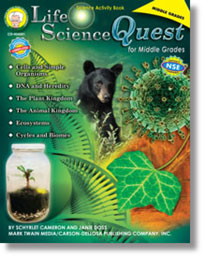
Life Science Quest for Middle Grades
Life Science Quest for Middle Grades encourages students to develop an understanding of the concepts and processes of science through the use of good scientific techniques. It is designed to promote scientific inquiry and can be used to teach the core science curriculum by itself or as a supplement. The book supports the National Science Education Standards, with the correlation for each unit listed in the teacher resource pages. Teacher resource pages also give an extensive list of the concepts that will help the teacher organize the lessons. Enrichment activities, interactive websites, and answer keys guide the teacher through each unit. Lessons use a variety of effective teaching strategies, including labs where students can experiment, observe, and infer. Topics covered include cells, DNA, heredity, simple organisms, plants, animals, ecosystems, and biomes. Written projects, graphic organizers, hands-on activities, glossaries, and reviews help students practice, reinforce, and retain key life science concepts and vocabulary. For state, national, and provincial standards correlations, visit www.carsondellosa.com.
CD-404091, 96 pages, 8.5" x 11"  
$10.99
Click here to see State Correlations and order
|
|
|
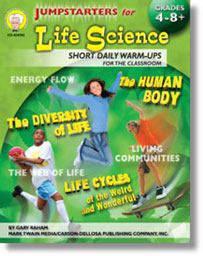
Jumpstarters for Life Science
Just as warm-up exercises help an athlete prepare for a race, these short, daily warm-up activities will aid students in preparing for the day's lessons with challenging life science activities. In Jumpstarters for Life Science, the reproducible activities can be used separately day-by-day; as transparencies; as a useful aid to reinforce the week's lessons; for whole-class lessons; given as a whole sheet to be kept in a student's binder; or for something to keep on hand in a learning center for students who have extra time. Topics covered in this book include the diversity of life, energy flow in living communities, organization of the human body, life cycles of the weird and wonderful, descent and change over time, and humans in the web of life. Each section of the book focuses on a science process skill such as observing, asking, understanding, figuring out, doing, and finding out. Metric activities and conversion tables are also included. Answer keys are provided at the back of the book.
CD-404092, 48 pages, 8.5" x 11"
$6.99
Click here to order
|
|
| |
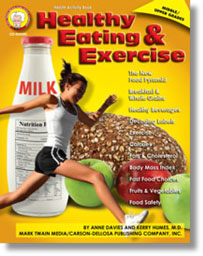
Healthy Eating and Exercise
Written by an M.D., Healthy Eating and Exercise provides students, teachers, and parents with up-to-date information on balanced and nutritious meals, healthy exercise, and food safety. Students will learn to personalize guidelines for their own diet and exercise using the new food pyramid, an exercise log, and assessments of their food intake. Topics covered include food labels, exercise, breakfast, whole grains, fruits and vegetables, sugar, and vegetarian diets. Sample menus and recipes for healthy foods are given throughout the book. The hands-on activities, games, and experiments in this book will help students make healthy choices that will stick with them for life!
CD-404090, 80 pages, 8.5" x 11"
$10.99
Click here to order
|
 |
| |
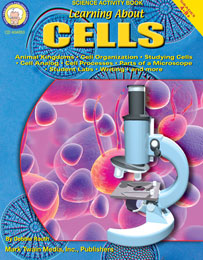
Learning About Cells
Learning About Cells introduces students to the fascinating world of cells. Students learn what cells are, how to use a microscope in order to view cells, the parts of cells, and how cells live and reproduce. A vocabulary list and a unit test help students prepare for assessment. The book supports the National Science Education Standards and was designed to supplement existing science curriculum. The lessons help students practice the scientific process as they make new discoveries about cells. Other books in the Learning About... series include Learning About DNA, Learning About Invertebrates, and Learning About Vertebrates. Grades 4-8+
CD-404050, 48 pages, 8.5" x 11"
$7.99
Click here to order
|
|
| |
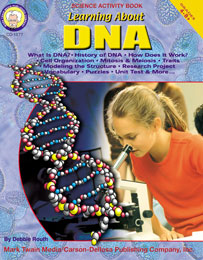
Learning About DNA
Analyze DNA, chromosomes, genes, cells, and all of the components of heredity! Students use many scientific process skills to observe, analyze, debate, and report. Worksheets, puzzles, a research project, and a unit test are included, as well as an answer key, bibliography, and vocabulary list. Grades 4-8+
CD-1577, 48 pages, 8.5" x 11"
$7.99
Click here to order
|
|
| |
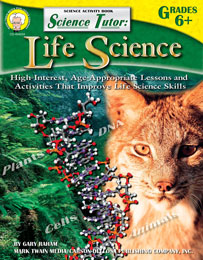
Science Tutor: Life Science
In Science Tutor: Life Science, each new concept is introduced in a short Absorb section. Key terms related to life science are highlighted in the text. Apply sections allow the student to exercise his or her knowledge of the concepts by answering questions, filling in the blanks, and engaging in short activities.
Science Tutor: Life Science is divided into four sections that explore patterns in the living world, energy flow in living systems, the human animal and levels of organization, and descent and change. At the end of each section, the student is invited to "put it all together" and test his or her understanding of each concept.
Because a lot of ground is covered in a short space, the visuals in this book are especially important. Illustrations and diagrams convey a large portion of the informational content and serve to organize ideas in relatively absorbable form.
Also available in this series are Science Tutor: Chemistry, Science Tutor: Physical Science, and Science Tutor: Earth & Space Science. Grades 6+
CD-404034, 48 pages, 8.5" x 11"
$6.99
Click here to order
|
|
| |
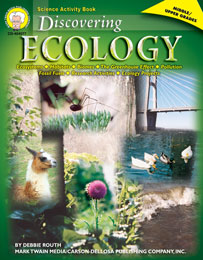
Discovering Ecology
In Discovering Ecology, students will learn about the biotic factors (living things) and the abiotic factors (nonliving things) that affect life on Earth. Students will explore the various habitats on Earth and the niches that organisms fill within those habitats. They will learn about the relationships among organisms in food chains and food webs. Cycles of resources, such as water, carbon-dioxide, oxygen, and nitrogen, are also illustrated. Students will examine air, water, and land pollution and how these contribute to climate changes, such as the greenhouse effect and global warming. Discovering Ecology supports the National Science Education Standards and is designed to supplement your existing science curriculum. A vocabulary study guide and a unit test provide tools for assessing the mastery of this ecology material. Research activities and ecology projects will help students learn science concepts while making a difference in their own communities. Grades 4-8+
CD-404077, 48 pages, 8.5" x 11"
$6.99
Click here to order
|
|
| |
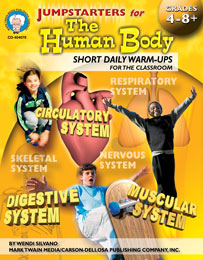
Jumpstarters for the Human Body
Just as warm-up exercises help an athlete prepare for a race, these short, daily warm-up activities will aid students in preparing for the day's lessons with challenging health and anatomy activities. In Jumpstarters for the Human Body, the reproducible activities can be used separately day-by-day; as transparencies; as a useful aid to reinforce the week's lessons; for whole-class lessons; given as a whole sheet to be kept in a student's binder; or for something to keep on hand in a learning center for students who have extra time. This book covers the major systems of the human body: skeletal, muscular, circulatory, digestive, respiratory, excretory, nervous, and endocrine. Diagrams of selected systems are included, as well as answer keys. Grades 4-8+
CD-404079, 48 pages, 8.5" x 11"
$6.99
Click here to order
|
|